
| Unsubscribe |
Hi, Tim Plaehn here.
Gold prices are breaking records.
But while everyone else is fixated on headlines…
They're missing something much bigger:
There's a new way to collect income from gold.
Not mining stocks.
Not options.
Not a single ounce of physical metal.
Instead, it's a $15 fund that's quietly paying out up to $1,152 a month to regular investors…
All thanks to a breakthrough strategy that transforms gold's rally into reliable monthly payouts.
Click here to discover the gold income breakthrough most investors are missing.
But move fast: the next payout is just days away.
To your income,
Tim Plaehn
Chief Income Strategist, Investors Alley
Albemarle’s Blowout Quarter Shows Why Lithium Still Matters
Submitted by Chris Markoch. Publication Date: 8/9/2026.

Key Points
- Albemarle beat Q2 earnings and revenue expectations as higher lithium prices helped drive a sharp rebound in adjusted EPS.
- Albemarle’s margins, cash flow and productivity improvements showed that the recovery extended beyond pricing alone.
- Albemarle still faces commodity-price volatility, but long-term lithium demand from EVs, energy storage and AI-related power needs supports the bull case.
- Special Report: SpaceX is offering you shares. Don't take them.
Albemarle (NYSE: ALB) faced high expectations heading into its Q2 2026 earnings report. The stock was down more than 30% from its 52-week high in June and more than 50% from its all-time high in 2022. It hasn’t been an easy stock to hold, but the company’s earnings report illustrated why that’s a sound strategy.
To sum it up, Albemarle’s adjusted earnings per share (EPS) rose more than 3,300% year over year (YOY). That’s not a typo. The company generated adjusted EPS of $3.75, massively higher than the 11 cents per share reported in the prior year.
ALERT: Drop these 5 stocks before the market opens tomorrow! (Ad)
The Wall Street Journal is already raising the alarm about a potential market crash, and Weiss Ratings research points to the first half of 2026 as a particularly rough stretch for certain holdings.
Some of America's most popular stocks could take serious damage as a radical market shift plays out. Analysts at Weiss Ratings have identified five names you may want to remove from your portfolio before this unfolds.
If any of these are in your portfolio, now is the time to review your positions.
See the 5 stocks to avoidThe gain was largely due to higher lithium prices. Still, the $3.75 in adjusted EPS was well above the forecast of $3.20. This was a strong number, and it wasn’t the only one. Revenue of $1.74 billion beat expectations of $1.61 billion and was 30% higher YOY.
Albemarle Earnings Show Lithium Recovery Is Real
But the quarter wasn’t just about pricing power. After all, the price of lithium is down about 30% from a peak of nearly $30,000 per metric ton reached earlier this year. That explains a significant portion of the dip in ALB stock.
Still, this is a moment when demand is reinforcing the case for owning a stake in the physical economy in 2026 and beyond. There may be some bumps along the way, but this is a long-term story with room to run.
Strong Execution Extends Beyond the EPS Beat
The EPS and revenue beats matter, but the details underneath tell a more durable story. Adjusted EBITDA came in at $858 million, up 155% year over year, while the margin expanded to 49% from just 25% a year ago. The takeaway is that evidence of pricing gains is flowing to the bottom line rather than being absorbed by costs.
Albemarle also delivered roughly $100 million in cost and productivity run-rate improvements in the first half of 2026. The company is on track to hit the high end of its $100 million to $150 million full-year target, with debottlenecking projects at La Negra, Jordan Bromine Company and its Chinese conversion facilities cited as concrete drivers.
The company is also generating cash. Operating cash flow conversion reached 69% in the first half of 2026, trending toward the company’s 60% to 70% long-term target after languishing as low as 37% in 2023. Free cash flow reached $638 million for the quarter, backing up years of management assurances about self-funded growth.
Not everything was clean. Albemarle flagged an estimated $70 million to $90 million unmitigated hit from Middle East-related supply chain disruptions and narrowed full-year lithium sales volume guidance to 225-235 kilotons LCE after a fire delayed the CGP3 expansion at Greenbushes.
That plant restarted Aug. 1 and should reach full production by Q1 2027, with better-than-planned output at the Wodgina joint venture largely offsetting the delay. It’s a reminder that Albemarle’s diversified asset base cushions single-site setbacks.
Why Lithium Demand Still Has Years of Growth Ahead
Lithium has become a foundational input to the physical economy. But it’s easy to overlook when the conversation remains fixated on software and AI. Every electric vehicle (EV), grid-scale battery and, increasingly, data center backup system depends on lithium-ion chemistry.
Albemarle’s own data shows that global lithium consumption increased 45% year over year through May. That’s ahead of the company’s already bullish 15% to 40% forecast range.
The clearest driver is energy storage. Global energy storage systems production has surged YOY in 2026, more than doubling at points earlier in the year, as utilities race to add capacity amid rising electricity demand. Some of that demand is coming from an unexpected place: AI data centers straining power grids and pushing automakers to repurpose EV battery lines for stationary storage instead.
Albemarle’s long-term forecasts call for stationary storage battery production to grow at a 20% to 30% compound annual rate through 2030. The company also forecasts that total lithium demand will nearly double, from 1.6 million metric tons LCE in 2025 to 3.6 million by 2030.
That’s the raw-material backbone for electrifying transportation, building grid resilience and now powering AI infrastructure. Investing in Albemarle is driven by the belief that physical inputs will remain scarce relative to demand, regardless of quarter-to-quarter price swings in lithium.
Why Albemarle Still Belongs in a Long-Term Portfolio
Is the post-earnings rally in ALB the start of a larger bull case for Albemarle? The answer is yes, but maybe not quite yet. Investors should strongly consider miners like Albemarle, which offer direct exposure to the commodities sector.
While not a precious metal, lithium will remain in high demand, with supply likely to lag. Albemarle is at the center of that story, which is a key reason why analysts continue to raise their price targets for ALB.
For the long-term thesis to collapse, every lithium application, including electric vehicles, battery storage and semiconductors, would have to show significant demand destruction. That seems unlikely.
But that doesn’t mean ALB won’t have volatility. Any stock that’s tied to a commodity will be a prisoner to that commodity’s price.
That volatility works both ways, which strengthens the case for a buy-and-hold strategy with ALB. Although the 1.27% dividend yield may not attract many income investors, the company has a track record of raising its dividend for 30 straight years, supported by steady cash flow and projected earnings growth.
Grab Holdings Stock Forms Bottom After Strong Beat-and-Raise Quarter
Submitted by Thomas Hughes. Publication Date: 8/4/2026.

Key Points
- Grab Holdings shares surged more than 5% after a strong Q2 report, with chart patterns suggesting a double bottom and potential price recovery.
- Analysts maintain a Moderate Buy consensus with 82% Buy-side bias among 11 analysts, indicating roughly 50% upside potential as of early August.
- Grab raised full-year guidance to 22% to 23% revenue growth and about 46% adjusted EBITDA margin, while expanding its buyback authorization to $1.75 billion.
- Special Report: SpaceX is offering you shares. Don't take them.
If market response is any indication, it is time to grab hold of Grab Holdings (NASDAQ: GRAB) and prepare for a bullish ride. After several quarters of weakness tied to macroeconomic headwinds, insider selling, regulatory changes and margin concerns, the bottom appears to be in and a price recovery is underway.
This well-positioned stock has hurdles to overcome, but it remains on track to deliver on its long-term targets, including steady growth, healthy margins and profitability.
FDA Greenlights New MS Therapy Aiming to Protect Myelin (Ad)
A NASDAQ-listed biotech just cleared a major FDA milestone. Its lead therapy, Lucid-MS, has been cleared for Phase 2 trials in progressive multiple sclerosis.
Unlike existing treatments that suppress the immune system, Lucid-MS is designed to protect myelin. In pre-clinical models, it led to movement recovery including walking.
Independent research projects peak annual sales up to 5 billion dollars, yet shares still trade under 5 dollars.
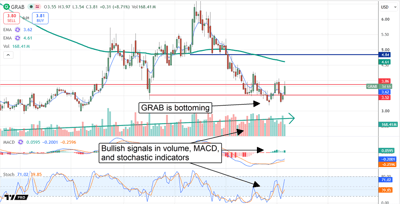
Learn why this FDA milestone could be a turning point for investorsThe chart action is textbook, reflecting the potential for a double-bottom pattern as of early August. The stock surged more than 5% following the Q2 earnings report, signaling strong market appetite while shares traded near long-term lows.
Both the MACD and stochastic indicators signal a potential price recovery. Each is bullish on its own, and together they form a textbook bottoming pattern, diverging from recent lows and turning bullish as the price formed its two bottoms.
The likely outcome is that GRAB completes its reversal. The only questions are how long it will take and how much upside potential remains.
Analyst and Institutional Support Point to Sustained Upside for Grab
The analyst trends were cautiously optimistic ahead of the release, with coverage increasing, sentiment firming and price targets falling. However, price-target reductions are unlikely to continue. Initial reactions reaffirmed the consensus, which stands at Moderate Buy, with an 82% buy-side bias among the 11 analysts tracked.
The consensus indicates 50% upside as of early August, and price targets could rise over time as Q2 results prompt a positive response from analysts. The likely outcome is that Grab continues to gain market share in the coming quarters, sustaining the bullish analyst trend and strengthening its upside potential.
Institutional activity reflects a cautious stance, with institutions selling in early Q3 ahead of the Q2 report. However, the strength of the results could accelerate institutional activity. Institutions own more than 55% of the U.S.-listed shares and have accumulated shares over the trailing 12 months and longer, setting the stage for continued institutional support.
Institutional activity and generally strengthening market support are reflected in the chart, with average volume steadily rising over the trailing three-year period. Volume may continue to increase in the coming quarters due to short covering. Short interest was not astronomical ahead of the release—only about 8%—but more than eight days to cover suggests that buyable shares could be scarce.
Grab Holdings Delivers Beat-and-Raise Quarter
Grab Holdings’ Q2 results revealed the strength of its model and market, with revenue growing 22% year over year and outpacing consensus estimates on strength across segments. On-demand gross merchandise volume grew 21%, underpinned by deliveries and the rapidly growing GrabMart division. This metric reflects the growing number of verticals and stock-keeping units (SKUs) available through Grab’s network, with transactions and SKUs up 54% and users up 42%.
Margin news was also a catalyst. The company is driving profitability through scale, leveraging its position to deliver a 54% increase in adjusted quarterly EBITDA, along with positive earnings and free cash flow. The only bad news is that earnings and free cash flow are down year over year, but the decline is mitigated by its cause: The company is investing in long-term growth and accelerating its shift to electric vehicles to insulate itself and its drivers from oil-price volatility.
Grab Raises Guidance: Cautious Outlook Sets Stage for Q3 Outperformance
Looking ahead, the company expects these strengths to continue. Full-year guidance was raised, with the previous high-end targets becoming the new low end. The new forecast calls for 22% to 23% revenue growth and widening margins, with adjusted EBITDA of approximately 46%. Given these trends, Q3 results are likely to outperform expectations.
One nearer-term overhang has already cleared: The recently announced regulatory changes in Indonesia are expected to hamper Grab’s margin only modestly and do not appear to be a major problem, leaving the company free to execute its strategy.
Grab’s primary risks are regulatory, given its expansive network and cross-border operations. These risks include commission caps, such as those in Indonesia, as well as acquisition scrutiny and project delays. The impact on the stock will likely be volatility, as these issues affect the quality and timing of revenue and earnings while also creating potential catalysts. Approvals and business expansion remain expected. Additionally, investors should be aware that Grab Holdings’ cash flow enables aggressive share buybacks. Q2 highlights included an additional $750 million authorization, bringing the total to $1.75 billion, which is expected to be executed over the coming two years.
This email content is a sponsored email provided by Investors Alley, a third-party advertiser of MarketBeat. Why was I sent this email?.
All information contained herein is copyright 2025, Magnifi Communities LLC.
If you have questions or concerns about your subscription, please don't hesitate to contact MarketBeat's South Dakota based support team at contact@marketbeat.com.
If you would no longer like to receive promotional emails from MarketBeat advertisers, you can unsubscribe or manage your mailing preferences here.
© 2006-2026 MarketBeat Media, LLC.
345 N Reid Place, Suite 620, Sioux Falls, S.D. 57103. United States of America..