Sign up to have posts delivered directly in your email inbox. Much of the content will be free, and there will also be weekly posts for paying subscribers only. I will be reporting from India and the neighbouring countries on stories the world needs to hear. I will interview journalists, writers and public intellectuals known globally for their profound expressions of discontent. There will also be ongoing discussions and debates with experts, policy makers, leaders and creative professionals, on current affairs, crises and humanitarian concerns. The uprising that exposed Narendra Modi may resurrect Rahul GandhiA Gen Z uprising has exposed the Modi government’s vulnerability and given Rahul Gandhi an opportunity to transform mockery into political power.
On Friday, Rahul Gandhi sat outside a police station in New Delhi beside Sahil Lochab, a 19-year-old protester whose body was pierced by pellets during a demonstration against India’s failing examination system. Lochab is now at risk of losing vision in one eye. Gandhi had accompanied him to demand that the police register a criminal complaint against the Delhi Police officers responsible for shooting at the student protesters. When the officers resisted, India’s opposition leader began a sit-in outside the station. Over the next six hours, Gandhi ate a mutton roll from the iconic Khan Chacha and drank Diet Coke alongside his sister, Priyanka Gandhi, as his team livestreamed the protest to an overwhelmingly Gen Z audience that amplified it across social media. 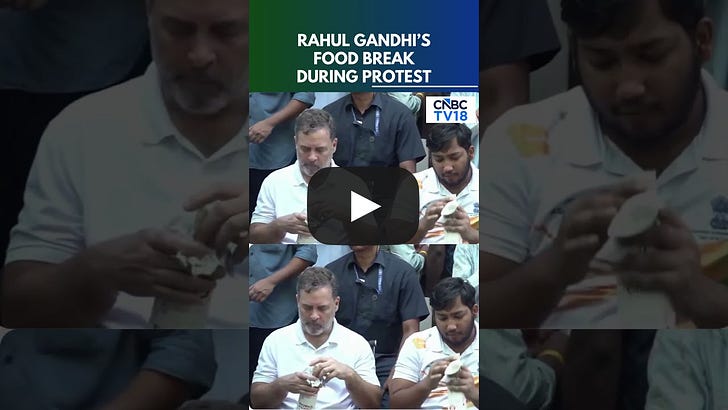
That evening, the police registered an FIR against unidentified individuals, marking what Gandhi called the first step toward justice. Delhi Police had previously denied using pellet guns during the protest. For nearly two decades, Gandhi, 56 was portrayed as an entitled and ineffectual politician who could neither revive the Congress party nor challenge the iron fist rule of Prime Minister Narendra Modi. This is Prime Minister Modi’ twelfth year in power as the longest serving head of the world’s largest democracy, second only to Prime Minister, Jawaharlal Nehru. The formidable online ecosystem supporting Modi’s Bharatiya Janata Party had over the years effectively reduced Rahul Gandhi to a caricature called “Pappu,” a Hindi diminutive suggesting a naïve and incompetent child. The insult was repeated through political speeches, television debates, memes, twitter trends and WhatsApp jokes by a well oiled machinery of the right wing ecosystem in India. The term stuck with many in the rest of the country including college students who came to see Gandhi as a loser—until “Pappu” became virtually synonymous with him. The ridicule extended to his family. Jawaharlal Nehru, Gandhi’s great grandfather and India’s first prime minister who was recast in online propaganda as a decadent, womanising aristocrat more interested in white women than India. (https://www.altnews.in/bjp-cell-head-amit-malviya-shares-affectionate-pictures-nehru-sister-niece-claims-hardik-patels-dna/ ) Gandhi’s mother, Sonia, was demeaned through false and misogynistic stories about her Italian origins, labeled an Italian bar dancer, while her son was depicted as a foreign educated dilettante disconnected from ordinary Indians This campaign accompanied the Modi government’s larger reconstruction of national memory: diminishing Nehru’s role in the independence struggle while elevating ideologues of Hindu supremacy. In this revised history, Modi represented an ascendant Hindu nation while Rahul Gandhi became the failed remnant of an exhausted dynasty. Over the last one year, especially since the GEN Z protests, something in that caricature has begun to break. Young social media users who once encountered Gandhi primarily through derisive memes now call him “bro,” “pookie” and a Gen Z political crush. Some young women circulate photographs and edits placing him alongside figures such as French President Emmanuel Macron and New York Mayor Zohran Mamdani. His presentation has evolved, too. The long kurta pyjamas of his early political career have largely given way to fitted T shirts and polo shirts that project informality, physical energy and distance from the ageing political establishment he is challenging. In a conversation with me, a longtime Congress insider who has worked with him extensively believed that the origins of Gandhi’s youth outreach can be traced to the Bharat Jodo Yatra, his nationwide march, where he walked across the country between 2022 and 2023. His conversations with students, unemployed graduates and a large population of gig workers, daily wage labourers convinced him that young Indians were exhausted by an old political establishment that neither understood their economic precarity nor spoke their language. 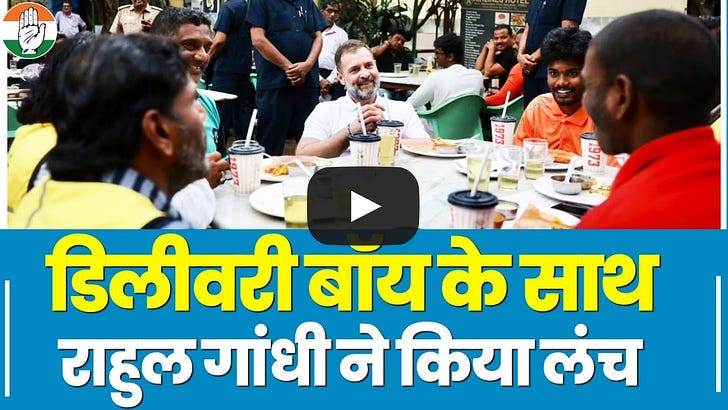
The recent Gen Z uprising transformed that diagnosis into an immediate political opportunity. The Cockroach Janta Party, an online satirical initiative that developed into a grassroots force, helped galvanize anger that had been building over paper leaks, recruitment delays, prohibitive education costs and unemployment. Gandhi did not create this movement, and he cannot claim ownership of it. But it appears to have amplified his determination to reach a generation that had previously taken pride in being apolitical. In June, Gandhi launched Chhatron Ki Goonj, or “The Voice of Students,” from Kota, the centre of India’s vast and unforgiving examination coaching industry. Through rallies, student interactions and an online petition, the campaign has invited young Indians to document their experiences of examination fraud, rising fees and disappearing jobs. In the northern city of Prayagraj, Gandhi condensed his argument into three Hindi words: dard, data aur daulat, pain, data and wealth. He sought to connect the private despair of unemployed graduates to a broader critique of an economy in which opportunity and power are increasingly concentrated. Gandhi has also sought out the young men and women who became the human faces of the protests. In August, soon after the GEN Z forced the education minister to resign, he held a videographed conversation with the faces of the movement. Gandhi then appeared with them before the national press. “You have done no wrong,” he told the protesters, rejecting attempts to shame them into apologizing for their defiance. 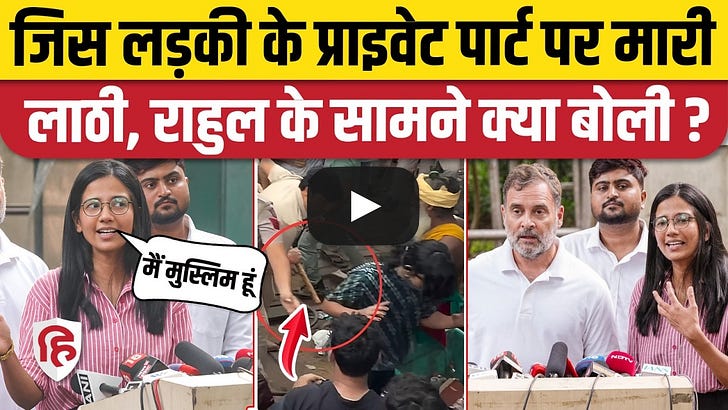
The following day, he opened an informal question session on Instagram with a direct invitation: “Students, Gen Z, I’m here to listen.” At a recent meeting of the Congress party, Gandhi and its senior leadership agreed to hold 800 meetings with students across India. Central to this outreach is an attempt to engage young women through “Smash the Patriarchy,” a campaign that speaks directly to their anger over the discrimination, harassment and violence that shape their everyday lives. Gandhi is simultaneously attempting to transform the meaning of his inheritance. He increasingly invokes Nehru, who spent approximately nine years in British prisons during the independence struggle, as well as the assassinations of his grandmother, Prime Minister Indira Gandhi, and his father, Prime Minister Rajiv Gandhi. He presents his family history not merely as a story of inherited power, but of sacrifice and violent loss. It is a calculated reversal of Modi’s most effective attack. Gandhi’s surname was long presented as proof that he had suffered too little to understand India. He is now using that same history to argue that few political families have paid a greater personal price for their idea of the country. For a generation increasingly distant from the independence movement, Gandhi is casting himself as the custodian of a democratic, secular and constitutional India threatened by Modi’s Hindu nationalism. That claim, however, faces a difficult test among the Muslim youth. Gandhi has forcefully spoken about the discrimination confronting Dalit (lower caste) students. But his critics ask why he remains reluctant to name the persecution of Muslims with the same clarity, particularly in the cases of student activists Umar Khalid and Sharjeel Imam. Khalid has spent nearly six years in prison without a trial, yet Gandhi has not made his case central to his defence of democratic dissent. A longtime colleague of Gandhi acknowledged to me that Congress had adopted a cautious approach, driven largely by an old guard fearful that an explicit defence of Muslims would allow the BJP to accuse the party of minority appeasement. Gandhi, the aide said, has argued vociferously inside party meetings that atrocities against Muslims must be identified by name. But private insistence is not the same as public political courage. If Gandhi wants young Muslims to believe that his constitutionalism includes them, he will eventually have to say outside those rooms what his aides say he argues within them. Yet Gandhi’s emergence matters. Modi cultivated young Indians through a language of aspiration, technological modernity and muscular nationalism. Gandhi is approaching them through vulnerability, listening and an acknowledgment of thwarted opportunity. He is also directly challenging the Rashtriya Swayamsevak Sangh (RSS), the ultraright Hindu nationalist organization that is the ideological parent of Modi’s Bharatiya Janata Party, accusing it of imposing a rigid, patriarchal and exclusionary conception of India. That challenge now resonates beyond the country. When RSS chief Mohan Bhagwat recently visited the United States, he was met with protests from members of the Indian diaspora. In the days that followed, at least 90 American politicians—including Democratic representatives Ro Khanna and Pramila Jayapal—pledged to reject campaign contributions from individuals and organizations linked to the RSS. Rahul Gandhi is outgrowing the propaganda that defined him. But escaping a caricature will not be the same as building an opposition capable of confronting a government that has corroded the institutions meant to protect Indian democracy. His real test ahead will be showing ordinary Indians that examination fraud, unemployment, police impunity and the persecution of dissenters are not isolated injustices, but symptoms of the same institutional decay. If he can do that, the generation that exposed a rare vulnerability in Modi’s government may also have produced the opposition leader Modi has never truly had to confront. You're currently a free subscriber to Rana Ayyub's Newsletter. For the full experience, upgrade your subscription.
|