India Policy Watch: IT Services In Trump’s CrosshairsInsights on current policy issues in India—RSJA quick run through global macros first. This week, the US Fed cut the policy rate by 25 bps, as expected. The Fed has been contending with a weakening labour market and growth pangs in the economy, while inflation continues to overshoot the target. The executive pressure from Trump to cut rates has also been a factor. While inflation expectation in the medium term is stable, the short term is muddied by the possible impact of tariffs on consumer prices. So far, tariffs have yielded about $90 billion in revenues (YTD) while the price impact has been absorbed by companies. This won’t continue for long, and eventually prices will rise. At this time, the Fed seems to be willing to live with the risk of moderate overshoot of inflation to support growth and maintain employment stability. Given that the US fiscal deficit will probably end up at least 75 bps higher than the forecast of 5.5 per cent, it will be interesting to see how the monetary transmission pans out. The market expectation is for a total of another 100 bps of cut over the next 15 months. I would be surprised if that were to happen, given inflation concerns and elections scheduled for 2026. Maybe a 25 bps before the end of this year and then hold will be the likely approach. Unless, of course, a Trump-nominated puppet becomes the Fed Chair and does his bidding on rate cuts (we will be in Turkey territory then). In any case, a total of 50 bps cut before the end of the year will open up the window for another cut in India, possibly by February. I don’t expect any cut before that timeline as the central bank and the government will want to see through the impact of demand boost coming from GST rationalisation in Q3 and a full transmission of the 100 bps rate cut already done for the year. A lot is hinging on the anticipated Q3 demand boost and the likely consumption flywheel it will set in motion. I remain somewhat sceptical about the sustainability of this demand boost. But we shall see. Separately, on Saturday, India woke up to the news of the Trump administration signing a proclamation that will raise the fee for H-1B visas to $100,000 annually. I have made this point a couple of times here that all it takes is for Trump to wake up one day and turn on the screws on the India IT services industry, and we will have a very different problem than the 50 per cent tariff on exported goods to manage. We might want to demonstrate strategic autonomy by cosying up to some kind of an anti-American front with photo-ops, interviews and military drills but these will come at a cost when dealing with this version of Trump. That cost is starting to pile up. The H-1B proclamation (as I see it) and the associated rhetoric from the administration around it isn’t pleasant reading for India. This might get worse from here.
Some context here. India accounts for 71 per cent of H-1B visas issued, and the target here is clearly the Indian IT services industry, including the growing GCC (global capability centre) business among the global MNCs in India. One way to look at this is to consider this $100,000 fee as the cost of doing business in the US and factor that into the global service delivery model and the pricing eventually. The standard response from IT services companies in the coming days will be to suggest a reorientation of the delivery model to hire more local talent (a trend that’s been on for the last decade), reduce dependence on H-1B, and absorb the additional cost of around $2 bn annually for the industry. The message will be that this is bad in the short-term on expenses, but we will manage it in the medium-term. Life will go on. While that sangfroid would be commendable and welcome, I suspect there is more to this proclamation than just a commercial dent to the IT services sector. The comment on the outsourcing companies engaging in visa fraud, money laundering, etc., should ring more alarm bells. I fear we will see a few high-profile cases that might be brought against the big Indian outsourcers in the coming days on these lines. The proclamation has some chilling language and specific allegations that are worse than just the $100,000 fee. From The Hindu again:
The likely reference above is to TCS, the largest Indian IT services company which announced a series of layoffs recently. It goes back to my point that some of the largest Indian IT services are in the crosshairs now. The second part suggests there might be some hurdles placed for US companies in their ability to lay off employees when they outsource work to India. This will make it difficult for clients of the IT services sector to make their outsourcing business case work. Taken together, unfortunately, this sounds like the beginning of a witch hunt to me. There will be more to come. What does India do with a problem like Trump? I had jocularly given a three-pronged solution to this a few weeks back based on ‘getting’ Trump. He is a megalomaniac who is difficult to deal with because he’s inconsistent. But the great opportunity he provides is that he’s totally unprincipled and without any shame. There is nothing final or definite with him because he will happily walk back on every commitment or promise he has made. This gives us a way to solve this problem. I will reiterate my solution somewhat more seriously now. One, go back to him with a statement that acknowledges his role in impressing upon Pakistan to step back and thus being instrumental in stopping the skirmish back in May. There is always a way to draft this in a manner that works for both parties. Then, India should nominate him for the Nobel Peace Prize (that he so wants) and promise him a Bharat Ratna next year (I’m not kidding). Two, India should get a couple of its biggest conglomerates (the usual suspects) to sign a few accelerated deals with the Trump extended family for building tens of Trump Towers and golf courses across 7-8 cities in India. India can afford a few more high-rise residential and office spaces, and nothing makes Trump happier than seeing his name bathed in neon light in the night sky. This is a low-cost move for everyone involved in India. Lastly, India should try to move a billion dollars or so of its forex reserve into crypto (preferably some Trump or Melania coin) with the pretext of diversifying risk. That’s it. These will hardly cost India a thing (maybe a few million dollars of real costs), but it will work like a charm. Trump will move on to some other ally (Japan, South Korea, Denmark, whoever) to harass instead of India. It is a low-risk, high-reward trade. All it needs is just a fraction of the shamelessness of Trump in implementing this solution, and this persecution will be over. We should choose it for the sake of national interest. A Counter-view: It’s Not About India—Pranay KotasthaneA trade deal will not end India’s problems, and the H-1B fee is not about India alone. I have updated my priors: the US seems to be undergoing a “cultural revolution with American characteristics.” It is tempting to think that foreign policy is at the forefront of the Trump presidency, but it is actually downstream of the domestic churn in American politics. Stephen Marche’s The Atlantic essay offers a compelling diagnosis:
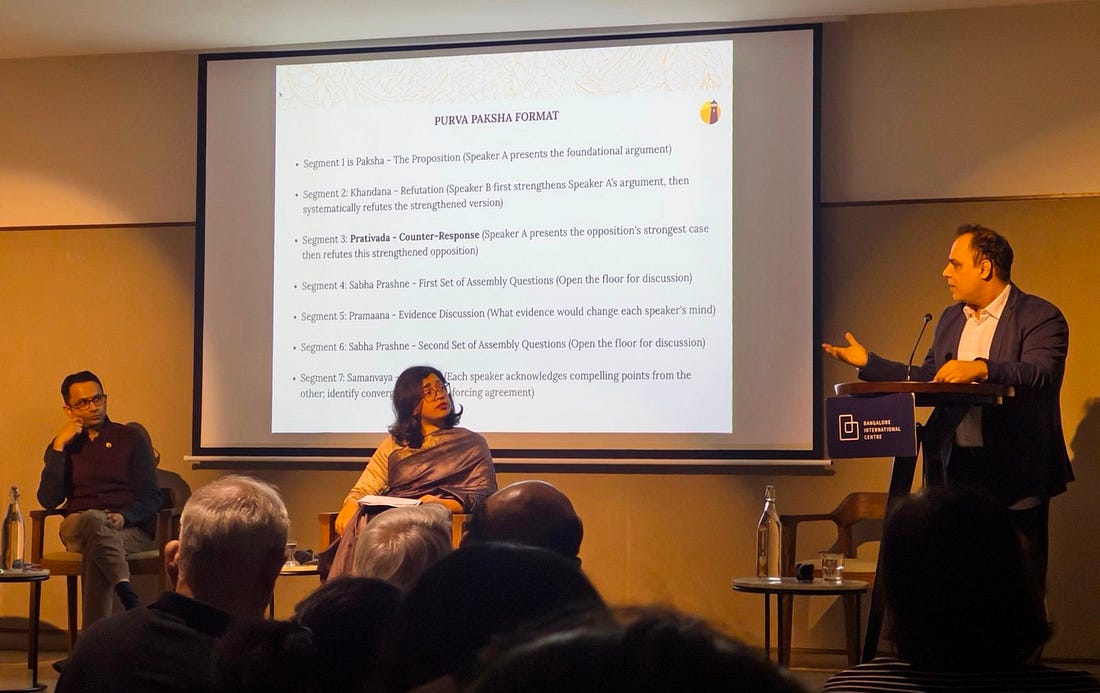
What we see with the H1-B change is precisely a ruling performer serving the narrative needs of his fans. Immigration is counterintuitive. It makes for a complicated narrative. “Immigrants take away American jobs” is an emotive story that the performer’s fans can relate to. Add the masala of visa fraud with a slice of money laundering charges, and Voila! We have a perfect narrative recipe. Indian IT is merely collateral damage. With Elon Musk—the only significant person in this administration supporting the H1-B regime—out of the picture, there is no pushback for this ‘masterstroke.’ I don’t think there is any going back on this in the Trump administration. It is not a negotiating tactic to extract concessions against India, but an outcome of putting performance ahead of governance. This brings me to what India should be doing. As I have written earlier, a trade deal is no endpoint. Ask the South Koreans, who had to face the ignominy of their nationals getting detained even after the country had signed a trade deal, which includes a $350 billion US fund to enable Korean investments in the US. Even if India were to bend backwards and offer all the things RSJ says, at no point will the persecution be over. As long as the cultural revolution in the US continues, countries will find themselves rotating in the entertainment crosshairs. That said, concluding a trade deal is desirable. The Indian Commerce Minister's visit to the US on 22nd September is a positive step. India should offer some tariff concessions, keep the scope limited to trade and investment, and refuse to engage with diktats that have a bearing on India’s national security. If this doesn’t work, we should sharpen the tools to inflict costs on the US, as discussed in the previous edition. More importantly, every new coercive act of Trump is an invitation for India to undertake domestic economic reforms. Once a trade deal has been signed under duress, any attempt at reform will be tainted as a weak play. It is one thing to use IMF pressure as an excuse to undertake economic reforms and entirely another to do something similar after Trump’s transgressions. In fact, the legitimacy of reform ideas will be highest in the current circumstances, when they can be projected as a strong counter-response to Trump’s bullying. Trade deal or not, the performer’s show will go on regardless of whether we give it a thumbs-up or not. Matsyanyaaya: The Case for a EU-India Open Tech MaitriBig fish eating small fish = Foreign Policy in action—Pranay Kotasthane & Anirudh Suri(This article first appeared in the fifth edition of India’s World magazine) In his opening address at the Paris AI Action Summit in February 2025, Prime Minister Narendra Modi made a strong case for open technologies, arguing, "We must develop open-source systems that enhance trust and transparency.” While this statement didn’t garner much attention, it has immense strategic importance for India and the EU, and can serve as the foundation for the India-EU technology partnership. Both India and the EU realise the significance of technology cooperation to their foreign policies. For this reason, the EU-India Trade and Technology Council (TTC) was created in April 2022 to respond to “challenges at the nexus of trade, trusted technology and security.” This initiative recognised that technological leadership increasingly determines geopolitical influence and therefore both sides need a structured mechanism to coordinate their approaches in an era of intensifying cooperation, competition and conflict over technology. Since its establishment, the TTC has conducted two ministerial meetings and one of its three working groups is focused on critical technologies, digital governance, and strategic technologies. The discussions in this Working Group have covered important ground, including artificial intelligence governance, semiconductor supply chain collaboration, and digital infrastructure security. These are vital areas of cooperation. However, a crucial component is missing in these discussions: a full embrace of open technology ecosystems - an ‘Open Tech Maitri’ - for both the EU and India to achieve digital strategic autonomy. Why Open Tech is Crucial for India and the EUBoth India and the EU approach technology geopolitics through the lens of digital sovereignty. In practice, however, both know that technology interdependencies will continue to exist even after attempts at building domestic capabilities succeed. This is because high-tech industries today rely on extensive cross-border movements of intermediate products, talent, and intellectual property. Successful companies only specialise in specific segments of tech global supply chains. Given this continuing interdependence, India and the EU must first distinguish tech dependencies from tech vulnerabilities. Vulnerabilities are characterised by overwhelming or total dependence on a single nation-state for a not-so-easily substitutable technology component. For example, the photolithography equipment for cutting-edge chips comes from one company - ASML. AI training depends overwhelmingly on one architecture - NVIDIA’s. And three providers - Amazon, Google and Microsoft - dominate cloud infrastructure. Each of these sectoral dependencies is a potential vulnerability. Tackling such vulnerabilities requires novel strategies because conventional methods to build domestic substitutes are too costly, time-consuming, and prone to failure. This is where open technologies provide an escape route. Open technologies accelerate development through rapid feedback cycles. When code is open, thousands of developers worldwide can simultaneously identify bugs, suggest improvements, and adapt solutions to local contexts. More crucially, the distributed nature of open source makes technology denial practically impossible. You can sanction a company or block exports of chips, but you cannot prevent developers from forking code repositories or implementing published research papers. The popularity of the open-source LLMs coming out of China is a case in point. Though they might still be marginally behind state-of-the-art (SOTA) proprietary models, their mere existence has made the denial of proprietary large language models obsolete. Such resilience is precisely what India and the EU need in an era of weaponised interdependence. Individual Initiatives Already ExistCrucially, India and the EU do not need to be convinced about the value of open technology, and are already doing a lot individually. A European Commission study from May 2021 estimated that open source software produces €4 of economic benefit for every €1 invested. A 10 per cent increase in open source software contributions would likely generate an additional 0.4% to 0.6% GDP annually, along with over 600 additional digital start-ups in the EU. Member states like Germany have a Sovereign Tech Fund to support the maintenance of critical open source projects that underlie global digital infrastructure. The European Commission has itself adopted and encouraged member states to prioritise open-source solutions in public procurement. The GAIA-X initiative aims to create a federated data infrastructure based on open standards. The European Processor Initiative funds companies to develop high-performance systems-on-chip using open architectures. India too realises the importance of open technologies in creating freer, fairer and competitive digital markets. The Modular Open Source Identity Platform (MOSIP) Project, incubated at the International Institute of Information Technology Bangalore, is an open-source foundational identity platform deployed by many countries. The Open Network for Digital Commerce (ONDC) is built on a Beckn Protocol, an open and interoperable protocol for decentralised digital commerce. On the hardware side, the Centre for Development of Advanced Computing (C-DAC) has developed VEGA processors based on the open RISC-V architecture. Yet despite this demonstrated commitment to open technologies, coordination between India and the EU is minimal. This is where an Open Technology Maitri comes into play, an idea first proposed in India's World in Issue 2. This Maitri is envisioned as a multistakeholder initiative to realise the vision of techno-strategic autonomy by advancing legal and policy pathways for open tech deployment and uptake. India and the EU are the perfect partners to kick off this Maitri. Here, we identify specific proposals in three domains: AI, Semiconductors, and Standards. Breaking the GPU Stranglehold in AIThe current AI ecosystem faces a critical vulnerability: most development depends on Compute Unified Device Architecture (CUDA), NVIDIA's proprietary programming platform. This creates a vendor lock-in to specific hardware and proprietary software stacks. An India-EU partnership could focus on supporting open generic software frameworks to reduce this critical vulnerability. Consider OpenAI Triton, an open-source alternative to CUDA that allows AI models to run on diverse hardware, or Apache TVM, which optimises machine learning workloads across different processors. These projects need sustained funding and developer ecosystems to compete with proprietary alternatives. India brings software expertise and scale, while the EU brings its world-class research infrastructure. Further, the Maitri could support projects developing open options for the entire AI stack. For example, it could fund moonshot projects to create open Graphics Processing Unit (GPU) architecture projects like Libre-SOC. The goal of this partnership should be to ensure that the next DeepSeek moment doesn't depend on any single company's hardware. Collaborate on Open Hardware ProjectsSemiconductor design uses specialised software called electronic design automation (EDA) that combines blocks of licensed intellectual property (IP). The market for EDA and IP is heavily concentrated in a few countries. The three EDA makers, Cadence Design Systems, Synopsys, and Siemens EDA, are headquartered in the US. Regarding licensed IP for processors, a UK-based company, ARM Holdings, alone powers 90 per cent of mobile-phone application processors. To balance against this market concentration, the EU and India must encourage open source alternatives. For instance, India announced its plans to join the global non-profit organisation RISC-V International as a premier board member in 2022 (RISC-V is a leading open standard for processors). Taking a cue from this policy instrument, India and the EU can come together to identify, support and build global open source alternatives for EDA software and processor IPs. For example, OpenROAD, an open-source EDA toolchain, currently handles only simple chip designs. With joint India-EU funding, it could evolve to handle complex system-on-chip designs. US’ DARPA funded the Metal Oxide Silicon Implementation Service (MOSIS), which allowed US fabless start-ups to produce chips quickly. The Maitri, too, must enlist government research fabrication facilities in this project through a MOSIS equivalent fabrication service. Open StandardsThe Maitri can also facilitate the creation of open standards in select strategic domains such as telecom or cybersecurity. While 5G deployment happens, the Maitri could jointly develop open 6G and 7G standards. Building on India's 5G testbed and the EU's Smart Networks and Services Industry Association, the Maitri could support reference implementations that prevent future vendor lock-in. The EU has a significant presence in the International Telecommunications Union (ITU) and other technology standards-setting organisations, in addition to having its own standards-setting bodies such as the European Telecommunications Standards Institute (ETSI). As it has started to do recently, the EU - with support from India - could actively shape the global agenda for standards to be more oriented towards open technologies. The three ideas above are indicative of the breadth and depth the Maitri could assume. The crucial point is for India and the EU to institutionalise the Open Tech Maitri to generate, select, and implement ideas. This could happen through various mechanisms. One, by opening a Joint Open Source Programme Office with a simple mandate: fund projects that reduce critical vulnerabilities through open alternatives in the priority sectors as jointly identified by the EU and India. Two, Strategic Procurement Commitment, where governments could commit that a portion of technology procurement will prioritise open solutions. This creates guaranteed markets for open alternatives, encouraging private investment. Three, greater collaboration and alignment between the EU and Indian representatives within key technology standards-setting organisations could help boost the adoption of open standards globally. With geopolitical tensions rising, companies and countries are looking to build dominance and exercise monopoly power. Open alternatives, in contrast, provide a clear way for other players to prevent such dominant structures in the technology markets. The India-EU Open Tech Maitri is about nurturing these alternatives. Moreover, this partnership could grow to include other partners who are similarly placed and concerned. The Tech Maitri could be a way to execute the Prime Minister's call for open-source technologies. The two Unions are uniquely placed and aligned to launch this initiative. A Framework A Week: The Purva Paksha DebateTools for thinking about public policy— Pranay KotasthaneFor a long time, we have felt that the debate format is broken. It's geared toward winning arguments rather than understanding them. It serves the purpose of competing but not the purpose of sense-making. So, the Takshashila Institution debuted a new-old format for high-quality discussions based on the purva paksha tradition. Purva paksha is the idea of strengthening the opposing viewpoint before refuting it. In modern parlance, it is called Steelmanning. But Purva Paksha is an ancient Indian tradition of analytical reasoning, and many texts are written in this style. For example, Arthashastra roughly uses this style—Kautilya first lists the best form of opposing arguments before offering his own. I find that Ambedkar’s writing also often adopts this style. We have built on the purva paksha idea to develop a new debate format. It has one moderator and two speakers presenting the opposing views. The debate can have the following seven segments.
Try this format in your schools, colleges, and workplaces.
HomeWorkReading and listening recommendations on public policy matters
|